
Retired WSF Captain: ‘In 10 years time, WSF will be crippled’ by a lack of vessels
CNL3 ‘s 48th Parallel News EXCLUSIVE
by Jeff Noedel
Video directed by Jeremy Tyler
Video edited by Jeff Noedel
Thursday, March 26, 2026
A CNL3 EXCLUSIVE VIDEO CAN BE SEEN AT THE BOTTOM OF THIS PAGE
Retired Washington State Ferries’ Captain Ken Burtness has been thinking about going public with his worries about the state of the WSF fleet for the past year.
Last year, Burtness began to draft a document intended for the public, which laid out his concerns. But in February, when the chairmen of the Senate and House Transportation Committees turned down Gov. Bob Ferguson’s proposal to borrow $1 billion to build three more WSF vessels, Burtness went back to his computer and changed the name of his draft document to “A Certain Crisis.” A link to that document is at the bottom of this article.
“Why now?” Burtness said. “After a lot of hope going back a number of years, when contracts were finally signed and a build schedule of 2030, 2031, 2032 was set, it became given that WSF was not going get the new boats it needs. (My) main goal is to get the Legislature to understand that they have to fund new boats, that they cannot continue the pattern of the last 27 years and keep putting it off.”
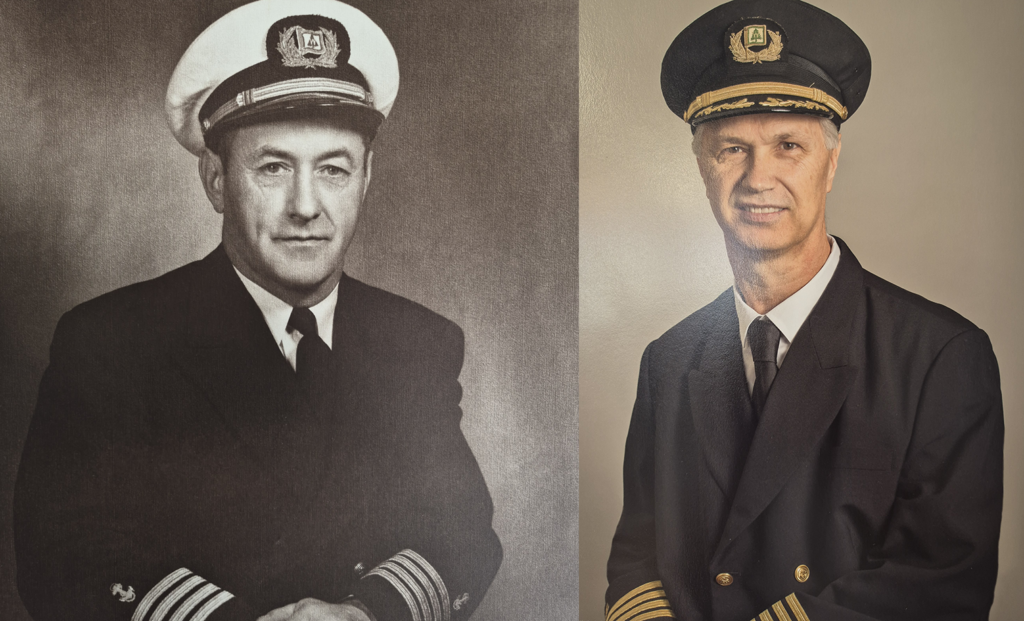
Burtness is a resident of Lopez Island for 48 years and has been a member of the San Juan County Ferry Advisory Committee for the past decade. WSF was the only employer in his entire life; he started with the ferry service when he turned 16 and he retired as Captain in 2008. He followed in the footsteps of his grandfather, Captain Earl Fowler, who was in the class of the first captains for WSF, starting in 1951. Two great uncles also worked for WSF.
Burtness is objective about his former employer. He speaks highly of Steve Nevey’s leadership of the service. And he credits Governors Jay Inslee and Bob Ferguson, as well as the State Legislature, for funding the rebuilding of the WSF workforce. And he is an avid consumer of documents prepared for the public by WSF and its parent WSDOT.
In fact, Burtness’ current campaign to enlighten the public is based mostly on focusing attention on the words in official documents published by the state government, notably the WSF 2040 Long Range Plan, published in 2019. As he refers to numerous warnings over past years about the faltering condition of the WSF fleet, he sometimes adds his own personal impressions of WSF vessels that he himself piloted from through the 1990s and 20-aughts.
“Most of my career was in what I now refer to as the “Golden Age of WSF”, said Burtness. There was never a shortage of boats and 11 new boats were built between 1970 and 1999. In the San Juans there was a steady increase in the level of service through all those years to meet increasing demand. Even though no new boats were built from 1999 until I retired in 2008, it had not become apparent yet that we would get to where we are now with half the fleet needing to be retired sooner than new boats can replace them.”
Burtness told CNL3 he feels “dumfounded” by what he perceives as state leaders “finding every excuse we can find to put off building enough new ferries for 27 years now. We have the breaking point for WSF in our sights. I just do not understand the lack of understanding that seems apparent, to me anyway, of how close WSF is to breaking.”
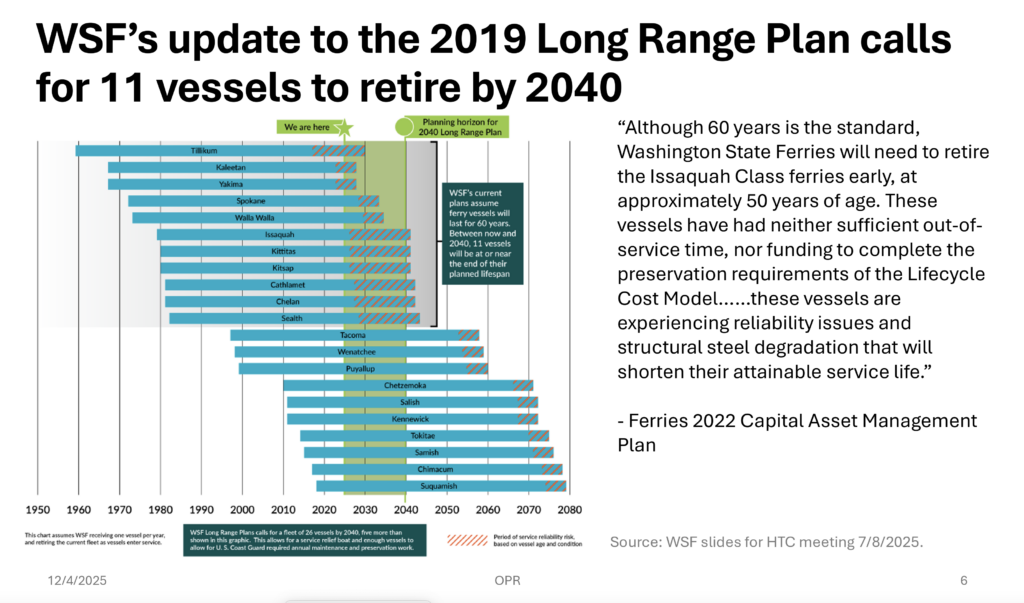
In an exclusive video interview with CNL3, Burtness tried to draw attention to a December report to the State Legislature about a vulnerability in the future WSF fleet posed by six WSF vessels built between 1979 and 1982, known as the Issaquah Class. Warning about the Issaquah Class boats come not from anonymous informants or conspiracy theorists, but from experts in State government.
One result of the State falling behind in buying new vessels is its policy to set the retirement age of vessels at 60 years, instead of the industry norm for ferries of 30 years.
But the quality of the six Issaquah class vessels is so much in question that State leaders have been told not to expect those vessels to last 60 years, but instead 50 years. And those 50 year birthdates begin in just 3 years.
CNL3’s video interview of Ken Burtness, conducted in mid-March 2026, is below.
CNL3 covers subjects important to residents of The Salish Sea — 600,000 Washingtonians who reside in the seven Counties of Whatcom, Skagit, Snohomish, San Juan, Island, Jefferson, and Clallam — plus 400,000 who reside in southern Vancouver Island, including Victoria, Sidney, and Nanaimo. CNL3 produces “48th Parallel News.”
CNL3 is based in Port Townsend, Washington.
LINK TO YOUTUBE: https://youtu.be/swXp-Md21ho?si=mC0RBPCGkv5eczoV
LINKS:
“A Certain Crisis,” by Ken Burtness” March 12, 2026
WSF 2040 Long Range Plan